
Show table of content Hide table of content
Red Bull Advanced Technologies has torn up the automotive rulebook with the RB17 hypercar, a track-only monster designed without compromise. When Adrian Newey, the legendary F1 aerodynamicist, received carte blanche to create the ultimate driving machine just before his move to Aston Martin, he delivered something unprecedented. This isn’t a hypercar tamed by road homologation or racing regulations. It’s pure engineering freedom translated into carbon fiber, titanium, and screaming mechanical fury. With 1,200 horsepower propelling just 900 kilograms, the RB17 exists in a realm where physics bend and conventional automotive wisdom collapses.
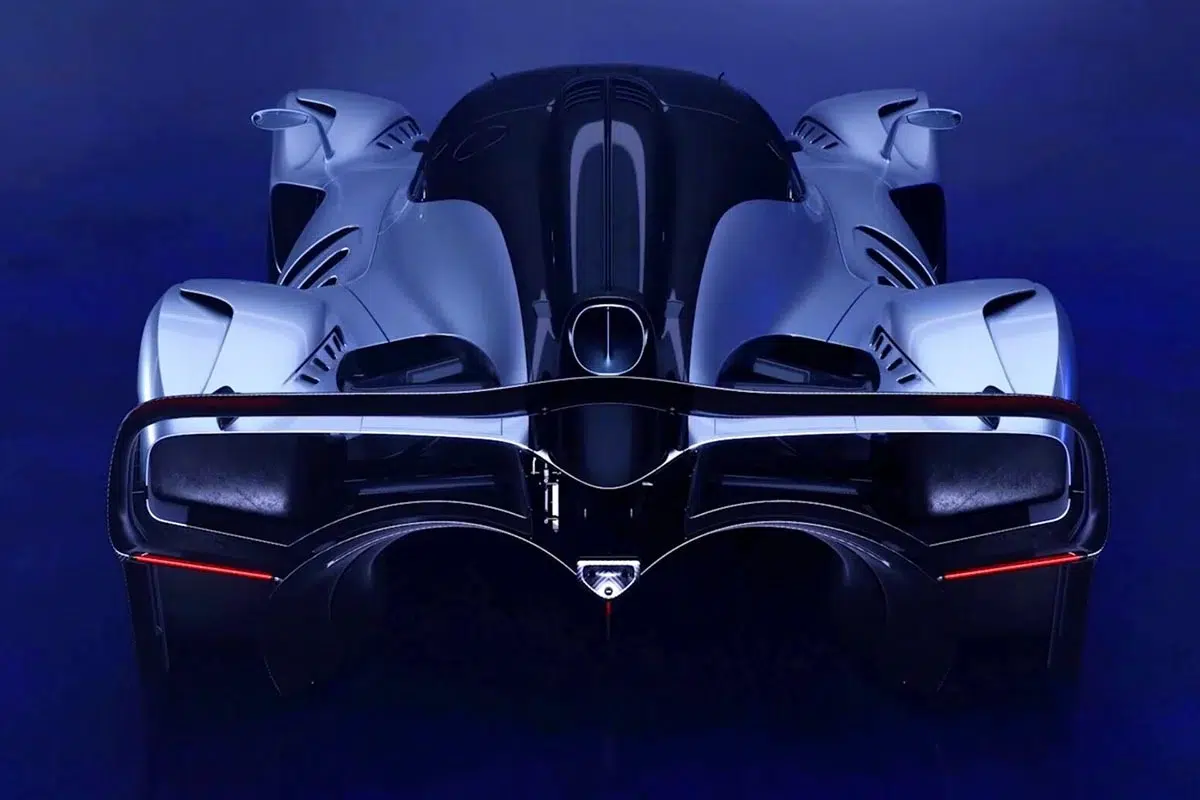
The machine made its debut at Goodwood Festival of Speed, immediately capturing attention with proportions that looked more spaceship than automobile. Since then, refinements have sharpened its edge further : a new dorsal fin, dual Venturi tunnels, physical mirrors replacing cameras, and repositioned exhaust outlets that maximize aerodynamic efficiency. Every surface, every vent, every angle serves the singular purpose of annihilating lap times on private circuits around the world.
Engineering without boundaries : the RB17 philosophy
What happens when you remove every regulatory constraint from automotive design ? The RB17 answers that question emphatically. Unlike hypercars such as the Mercedes-AMG One or Aston Martin Valkyrie, which made compromises for road legality, Red Bull’s creation acknowledges no such limitations. It exists solely for private circuit use, liberated from crash test requirements, emissions standards, or competition regulations that would dilute its performance.
NewsToyota GR86 Outroad : the off-road sports car dream from JapanAdrian Newey approached this project as a manifesto of what modern engineering can achieve when unleashed. The result transcends traditional automotive categories, sitting somewhere between LMP1 prototype and Formula 1 monoplace. This radical positioning targets an ultra-exclusive circle of enthusiasts capable of piloting something faster than current Grand Prix cars on certain circuits. The RB17 doesn’t compete with other hypercars because it exists in a different dimension altogether, one where lap times matter more than comfort, where mechanical purity trumps creature conveniences.
The carbon monocoque forms the foundation of this philosophy, engineered with Formula 1 construction techniques but without weight-adding safety structures mandated by road homologation. The two-seater configuration, unusual for such an extreme machine, allows owners to share the experience with instructors during the comprehensive track program Red Bull provides. This isn’t a garage trophy but a living, breathing instrument that demands respect and skill to exploit properly.
A naturally aspirated V10 screaming to 15,000 rpm
At the heart of the RB17 beats a Cosworth-developed 4.5-liter V10 that revives the golden era of naturally aspirated engines. This masterpiece produces 1,000 horsepower on its own, reaching a stratospheric 15,000 rpm redline that modern turbocharged units can only dream about. The acoustic experience alone justifies the engineering investment, delivering a mechanical symphony unheard since the V10 F1 era of the 1990s and early 2000s.
Complementing this atmospheric marvel, a 200-horsepower electric motor provides hybrid assistance without compromising the engine’s character. Unlike complex Formula 1 hybrid systems focused on efficiency, the RB17’s electric component serves purely to enhance performance. It fills torque gaps, improves corner exit traction, and ensures instantaneous throttle response throughout the rev range. The marriage between old-school combustion passion and modern electric precision creates a powertrain unlike anything else on four wheels.
| Component | Specification |
|---|---|
| Engine type | Naturally aspirated V10 |
| Displacement | 4.5 liters |
| Maximum rpm | 15,000 rpm |
| ICE power | 1,000 hp |
| Electric motor | 200 hp |
| Total output | 1,200 hp |
| Dry weight | 900 kg |
| Power-to-weight ratio | 0.75 kg/hp |
That 0.75 kg/hp power-to-weight ratio places the RB17 in territory normally reserved for racing prototypes. For context, even the most radical track-focused Porsche 911 GT3 variants operate with significantly less favorable ratios. The engineering team achieved this remarkable figure through obsessive weight reduction across every component, from titanium fasteners to minimalist interior appointments that prioritize function over luxury.
Aerodynamic mastery generating 1,600 kg of downforce
Where the RB17 truly distinguishes itself is through aerodynamic solutions banned in regulated motorsport. Freed from FIA restrictions, Newey implemented technologies that push downforce generation beyond anything currently racing. The result : over 1,600 kilograms of aerodynamic load at speed, nearly double the car’s actual weight. This creates cornering forces that would be physically impossible with conventional automotive aerodynamics.
NewsBMW Alpina officially becomes the group’s new luxury brand, what this upheaval changes for the entire automotive industryThe underbody features innovations that Formula 1 outlawed years ago :
- Fan-assisted ground effect that actively pulls the car toward the track surface
- Blown floor channels directing exhaust gases to enhance venturi tunnel efficiency
- Active suspension systems that maintain optimal ride height regardless of loading
- Dual venturi tunnels sculpted with computational precision for maximum suction
- Dorsal fin channeling airflow over the cockpit to the massive rear wing
Every external surface contributes to the aerodynamic performance. The vertical-opening doors aren’t just dramatic theater; their design channels air toward heat exchangers while creating additional downforce. Side intakes feed both engine cooling and aerodynamic structures underneath, demonstrating the integration between form and function. Even the repositioned exhaust outlets play dual roles, managing thermal signatures while contributing to rear diffuser efficiency.
This level of aerodynamic sophistication demands extraordinary pilot skill. Red Bull recognizes this reality, offering clients comprehensive training programs complete with telemetry analysis and professional simulator sessions. The RB17 isn’t forgiving like typical hypercars; it requires commitment and technique to explore its performance envelope safely. Much like how specialized vehicles demand adapted driving approaches, the RB17 necessitates recalibrating everything pilots think they know about car control.
Exclusivity redefined : fifty units at 5.5 million euros
Far from remaining a concept, the RB17 enters limited production with just fifty examples planned. Each carries a base price of 5.5 million euros before customization options, which will be extensive given the bespoke nature of the project. Red Bull carefully curates the client list, seeking owners who will actually drive these machines rather than entomb them in climate-controlled collections.
The purchase price includes far more than the vehicle itself. Buyers gain access to an exclusive performance program spanning the world’s greatest circuits. Personalized coaching from professional drivers, telemetry analysis sessions, and simulator training ensure owners can safely extract the RB17’s capabilities. This transforms ownership into an ongoing relationship with Red Bull Advanced Technologies rather than a simple transaction.
News810 Hp Mustang supercharger kit costs less than a Dacia SanderoIn an automotive landscape increasingly dominated by electrification mandates and regulatory constraints, the RB17 represents defiant anachronism. It proves that when engineering creativity faces no boundaries, the results can still inspire, thrill, and challenge our perceptions of what vehicles can achieve. This philosophy resonates with other manufacturers pursuing high-revving naturally aspirated experiences in modern packages, though none match the RB17’s extremity.
The RB17 ultimately asks whether automotive passion requires practical justification. Red Bull’s answer arrives unmistakably : sometimes the pursuit of absolute performance needs no rationalization beyond the visceral experience of mechanical perfection screaming at 15,000 rpm.
